Agadir Has No Old Town: Where the Culture Actually Is
Updated September 24, 2026 · 6 min read
Travellers arrive in Agadir expecting what Marrakesh and Fez have — lanes, a walled old quarter, a thousand years of city. Agadir does not have that, and no amount of looking will find it. Saying so plainly is the useful thing, because it changes what is worth your afternoon.
What happened, and why nothing looks old
At 11.40 pm on 29 February 1960 — a date that only exists in a leap year — an earthquake of magnitude 5.8 struck directly beneath the city. Between 12,000 and 15,000 people died, about a third of Agadir’s population at the time. Nearly seventy percent of the city was left in ruins, and at least 35,000 people were made homeless.
What stands today was built after that. The wide boulevards, the low concrete blocks, the beachfront that runs for kilometres in a single unbroken line: this is a planned modern city, and it is planned the way a city is when the previous one killed a third of its people.
That is the context for everything below. Agadir’s cultural sights are a rebuilt fortress, a working market, and a reconstruction — not survivals.
The Kasbah: walls, a view, and a cable car
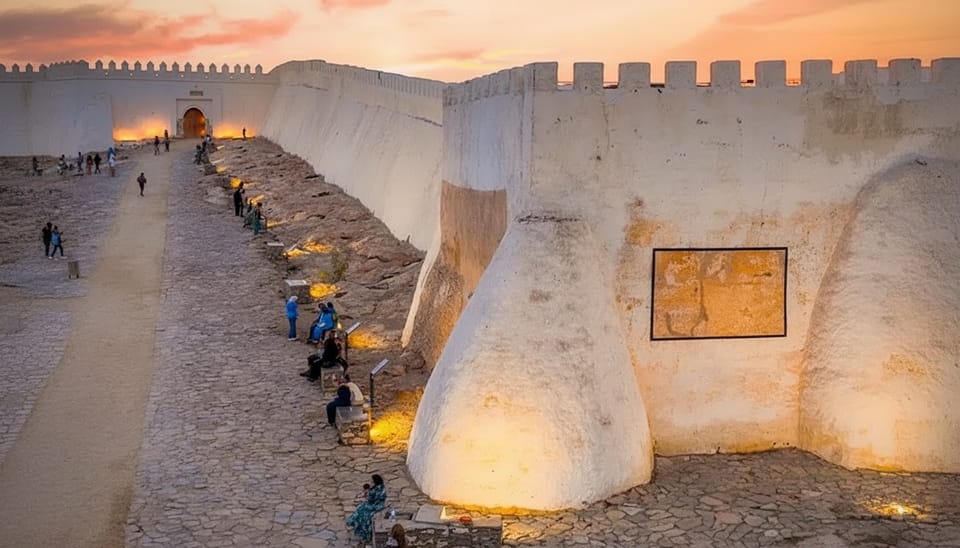
Agadir Oufella sits on the hill north of the port. The fortress walls predate the earthquake; what was inside them does not. The site is essentially the rampart, the hilltop, and one of the better views in Morocco — the whole bay, the port, and the city grid laid out below.
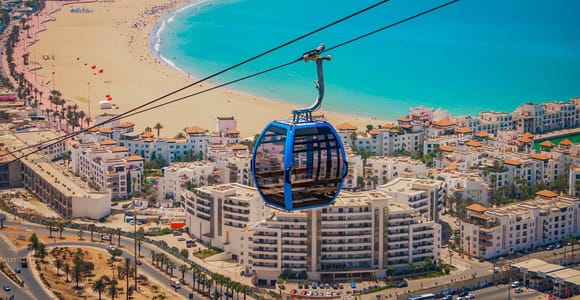
Since July 2022 a cable car has run up to it: the first in Morocco, about 1,700 metres long, roughly six minutes each way. It was built by the Swiss-Austrian firm Garaventa Doppelmayr. You can also drive or take a taxi up the road.
The thing to know before booking a guided city tour: the Kasbah entrance ticket is usually not included. The three-hour tour that carries the most reviews among the city tours says so explicitly in its exclusions, and it is the single most common surprise on the hill.
Souk El Had: the real one
If you visit one thing in Agadir, this is it. Souk El Had is a walled market of more than 6,000 stalls behind 13 gates, and it is where the city actually shops — spices, olives, argan oil, pottery, clothing, and produce in quantities that only make sense if you are feeding a family.
Two practical facts decide your visit:
- It is closed on Mondays. Every Monday. This trips up more visitors than anything else in Agadir, because half the city tours sell a version that includes it.
- The published hours are Tuesday to Sunday, 9am to 8pm, though individual traders keep their own time and many step away on Friday afternoon for prayers.
Sunday is busiest. Midweek is when you can actually move, look at something without an audience, and negotiate without a queue behind you. Prices are in dirham and are expected to be discussed; the first number is a starting position, not an insult.
The medina that is thirty years old
South of the city at Ben Sergao stands La Médina d’Agadir, begun in 1992 by the Italian-Moroccan artist Coco Polizzi. It is built with traditional Berber techniques and local materials — stone, rammed earth, wood — and it contains workshops, craftspeople and restaurants.
It is not the old town, and it does not claim to be. It is an artisan village in the form of one, and whether you like it depends entirely on whether you can hold both facts at once: the craft inside it is real, the antiquity is not. There is a modest entrance fee in dirham at the gate, and entry is free if you are only going to the restaurants.
Visitors who arrive thinking they are seeing pre-1960 Agadir feel cheated. Visitors who know what it is generally enjoy it.
What a city tour actually includes
The most-reviewed city tour in our stock is a three-hour tour at €15 with hotel pickup, a driver and a guide. Its itinerary is worth reading in full, because it is representative:
45 minutes at the Kasbah, 30 minutes at the Mohamed V Mosque, 30 minutes at a shop, and an hour at Souk El Had — with a quarter of an hour in the van between each.
That shop is not hidden; it is listed as a stop. It is also half as long as the hour you spend at the market. This is normal across the category and not a scandal, but it is the difference between three hours of sightseeing and three hours of which half an hour is retail. Ask before booking whether the stop can be skipped; some operators say yes.
Across the city tours category we hold 32 offers, from €9.60, median €27.42. The cheap end is transport and a guide. The top end is usually the cable car ticket bundled in — the combined cable car and guided city tour sits at €40.
Half a day that does not need a guide
You can do the culture on your own, and in a compact city it is easy:
- Taxi or cable car up to the Kasbah early, before the light goes flat.
- Souk El Had for a couple of hours — go with cash, small notes, and no schedule.
- The Jardin d’Olhão in Nouveau Talborjt, where the Musée Mémoire d’Agadir tells the story of 1960 properly instead of mentioning it in passing. The Amazigh Heritage Museum, with Berber jewellery, instruments and textiles, is on the same corner.
Note the pattern: the souk closes on Mondays, and so does the museum in the garden. Monday is the weakest day of the week for culture in Agadir — put the beach, the valley or the dunes there and keep the city for another day.
A guide earns their fee at the souk more than anywhere else, mostly by making the negotiation faster and less performative. Everywhere else you are fine alone.
If the craft rather than the city is what interests you, the argan co-operatives north of town show the oil being pressed by hand, and a cooking class gets you further into Moroccan food than any restaurant will. The wider list is on the things to do in Agadir page.